|
|
|
|
Return to Texas Entomology - Compiled by Mike Quinn
Link to sound files of this screaming loud insect
|
|
|
|
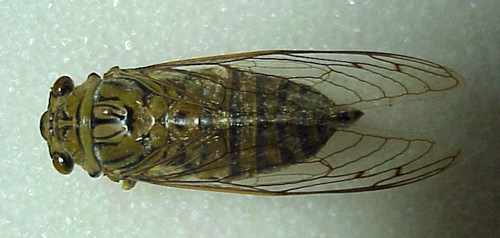
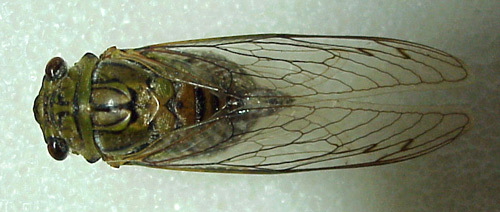
Male and Female Quesada gigas
Male has enlarged abdomen for a sound chamber
(Photos courtesy Charles Bordelon, Texas Lepidoptera Survey)
Most of the various Texas cicadas have a similar camouflaged appearance as they differentiate themselves by sound, not by looks.
|
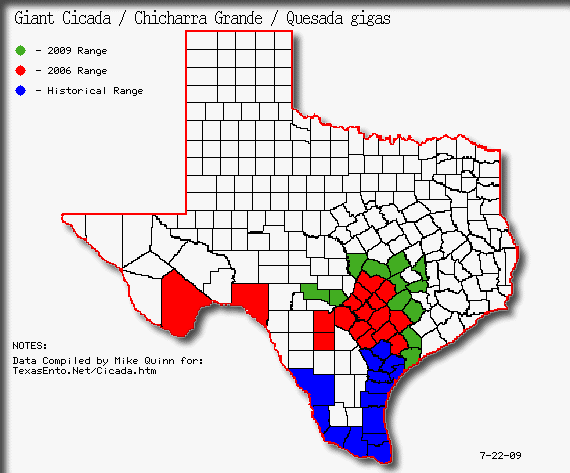
Blue counties are the species' historical range, most (if not all) of south Texas brushlands
Red counties indicate expanded range and increased
abundance for Q. gigas for 2006
Green counties indicate expanded range and increased
abundance for Q. gigas for 2009
Please report any additional counties to Mike Quinn
Range:
Giant Cicadas range from central Texas to central Argentina (Sanborn &. Phillips 2013). This is the widest ranging cicada in the Western Hemisphere and has almost no variation in its song throughout its range.
Davis (1944) reported the earliest Bexar Co. (San Antonio) records from 1934. From 2006 to 2009, this species was common and wide spread iacross central Texas, but has mostly been uncommon north of San Antonio since 2009.
iNaturalist (iNat) - Global Biodiversity Information Facility (GBIF)
|
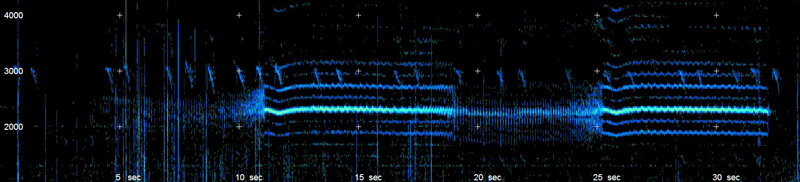
Audiospectrograph Courtesy David Huffman
Sound: chic-chic-chic-chic-chic, zwEEEEEEEEEEEEEEEEEEEEEEEE... song can be repeated without pause, see audiospectrograph.
WAV File (download) - July 10, 2006 - Universal City, Bexar Co. - Royce W. Johnson
MP3 File (plays directly) - June 10, 2007 - David Huffman, Prof. of Biology, Texas State University-San Marcos
WMA File (download) - July 26, 2009 - west bank of the Brazos River in Brazos Co. - Jane Packard, Wildlife & Fisheries Sciences, Texas A&M Univ.
MOV File (download) - Feb 17(!), 2017 - calling close to dusk at Estero Llano Grande State Park, Weslaco, Hidalgo Co. - Rick Snider, Park Host
If heard in the distance, only the "EEEEEEEEEEEEEEEEEEEEEEEEEEE..." portion may be audible...Sings primarily at dusk (between 8:37 and 9:04), and less often at dawn (between 6:15 and 6:25) in central Texas. Sings all day (and occasionally through the night) further south.
Note, there are over 40 species of cicadas in Texas, but the Giant Cicada is truly unique in terms of the sound it makes.
Comments on the Sound of the Beast:
Unlike crickets and grasshoppers which make sounds by rubbing their wings and legs together, male cicadas produce sound by vibrating special membrane-like structures (tymbals) on their abdomen. The male’s enlarged abdomen is mostly filled with an air sac that functions as a resonance chamber thus greatly amplifying their songs. (Triplehorn & Johnson, 2004)
Katydids such as the Central Texas Leaf-Katydid primarily sing from dusk on into the night, but during population outbreaks, Katydids may sing day and night!
Cicadas,
in general, are difficult to study as they spend their pre-adult life
underground, and their short adult life high up in trees.
Further
complicating matters is the fact that many species look very similar to
each other as they differenciate themseves by sound, not looks.
Calling site and calling posture:
Primarily inhabits the canopy with some individuals at low level, on trunks or on primary stems. No body movement during sound production. (Sueur, 2002)
Behavior:
Gregarious: static at low density but mobile at high density, males calling two or three times and then flying to another calling site. Sing in chorus with synchronization of the second high-pitched part of their song. (Sueur, 2002)
Life Cycle:
This species spends at least four years underground as immature insects feeding on tree roots, mostly Huisache and other members of the Legume family.
Size: Length from tip of head to tip of folded wings over 60 mm
Habitat: Secondary growth or forest remnants.
Host Plants: (Martinelli & Zucchi, 1997, Zanuncio et al., 2004)
Huisache (Acacia farnesiana), Caesalpinia peltophoroides, Cassia spp., Piptadenia sp., Schizolobium amazonicum - Legume Family Fabaceae
Mulberry (introduced) Morus alba - Mulberry Family Moraceae
Avocado - Persea Americana - Laurel Family Lauraceae
Cacao - Theobroma cacao - Cacao Family Sterculiaceae
Coffee - Coffea spp., Madder Family Rubiaceae
Similar Species: There are 166 species of cicadas in the United States and Canada. (Arnett, 2000)
North American Taxonomy: Checklist of Cicadas North of Mexico
Texas Taxa: There are over 40 species of Cicadas in Texas (Davis, 1944)
Cicada Checklist of Texas - Bibby (1936)
Identification: Key to the genera of temperate North American Cicadidae adults
Sings April to October in south Texas, but the height of the season is from June to July (Davis, 1944)
First Central Texas records for 2006:
- ~June 23 - Smithville, Bastrop Co. - Megan Lowery
- July 10 - Universal City, Bexar Co. - Royce W. Johnson
First Texas Records for 2007:
- May 17 - Bentsen-RGV State Park, Mission, Hidalgo Co. - Josh Rose
- June 10 - nr. San Marcos, Hays Co. - David Huffman
- June 22 - Port O'Connor, Calhoun Co. - Brush Freeman
- July 05 - large number calling - Brooks City-Base, Bexar Co. - Greg Hammer
- July 13 - two calling - Zilker Botanical Gardens, Austin, Travis Co. - Scott Young
First Texas Records for 2008:
First Texas Records for 2009:
June 01 - Edinburg, Hidalgo Co. - Anne Toal
June 24 - San Antonio, Bexar Co. - Lee Elliot
June 26 - Mission Valley, Victoria Co. - Ro Wauer
June 29 - nw San Antonio, Bexar Co. - Chris Collins
~July 01 - nw Burnet, Burnet Co. - Lee Kinard
July 03 - a few singing - s. of Bastrop - Brush Freeman
July 04 - Utley, Bastrop Co. - Brush Freeman
Significant Records for 2010
- March 07 to April 03 - Sabal Palm Sanctuary, Brownsville, Cameron Co., ex. Lindgren funnel trap - Ed Riley
- May 10 - Edinburg, Hidalgo Co. - Anne Toal
- May 07- May 21 - McManus unit, LRGV NWR, Hidalgo Co., ex. Lindgren funnel trap - J. E. King; E. G. Riley
- June 01 - 4 mi NWof Beeville, Bee Co. - Jimmy Jackson
- June 14 - Mission Valley, Victoria Co. - Ro Wauer
- June 20 - several singing - nr. Shiner, Lavaca Co. - Chris Collins
- June 23 - Grey Forest, Bexar Co. - Chris Collins
- June 28 - San Marcos, Hays Co. - David Huffman
- July 01 - Medina Co. - Maury Heiman
- ~July 01 - Kendall Co. - Kristie Denbow
- July 01 - a few mi south of Smithville, Bastrop Co. - Denis McGinness
- July 04 - Webberville, Travis Co. - Claude Morris
- July 04 - south of Cuero, DeWitt Co. - Larry Koenig
- July 04 - Bellville & Piney Creek area, Austin Co. - Troy Gosney
- July 05 - FM 969, just e. of Bastrop/Travis County line - Dale Tilson
- July 05 - s. Austin, Travis Co. - Mike Quinn
- July 07 - Universal City, Bexar Co. - Royce W. Johnson
- July 08 - north central Austin, Travis Co. - Timothy Scoggins
- July 08 - at least 6 to 10 singing - 8 mi e. of Bastrop - Brad Watson
- July 09 - e. Austin, Travis Co. - Ken Casey
- July 09 - Chappell Hill, Washington Co. - Darrell Voller
- July 09 - Brenham, Washington Co. - Kathy Milenki
- July 10 - Ward, Jackson Co. - Brush Freeman
- July 10 - 2.1 mi south of Elgin, Bastrop Co. - Steve and Lisa King
- July 11 - Riata Pond in NW Austin, Travis Co. - Bill Dodd
- July 12 - City of Lockhart Park, Caldwell Co. - Eric Isley
- July 12 - Cedar Park, Travis Co. - Ramona Urbanek
- July 12 - Meadow Lake, Round Rock, Williamson Co. - Byron Stone
- July 13 - Ranch in Kerr Co. - Tom Collins
- July 19 - near Thorndale, Milam Co. - Bill Narum
- July 22 - nr. Thomas Park, College Station, Brazos Co. - Mary Dabney Wilson
Significant Records for 2011
- ca. June-July - 39 yo life-long resident of Taylor, Williamson Co. heard a total of 5 or 6 times. Had never heard it before - Dell Buckalew, plus family members
Significant Records for 2012
- ca. June-July - Heard one time in Taylor, Williamson Co. - Dell Buckalew
- July 6 - Gonzales Co. - Colette Micallef
- July 8 - One calling at 2044 - Utley, Bastrop Co. - Brush Freeman
- July 10 - repeatedly heard one or more - 4 mi NW of San Marcos, Hays Co. - Donna Browning
- July 25 - Utley, Bastrop Co. - Brush Freeman
Significant Records for 2013
- April 5 - Weslaco, Hidalgo Co. - Brush Freeman
- July 3 - Taylor, Williamson Co. - Alicia Buckalew
- July 6 - Helotes, (San Antonio) Bexar Co. - Chris Collins
Significant Records for 2016
- July 28 - "Upon return to San Marcos yesterday evening, I also heard several calling well before dusk on Hilliard Rd off Lime Kiln Rd." - David Huffman
Significant Records for 2017
- "I heard them through December 2016 in Hidalgo county." - Raul Garza Jr., USFWS Park Ranger, Santa Ana National Wildlife Refuge, Hidalgo Co.
- Feb. 17(!) - calling (download) close to dusk at the Pauraque hall garden at Estero Llano Grande State Park, Weslaco, Hidalgo Co. - Rick Snider, Park Host, Estero Llano Grande State Park
- Feb. 21 - ostensibly the same individual called again at 6:30PM dusk - Estero Llano Grande State Park, Weslaco, Hidalgo Co. - Rick Snider, Park Host, Estero Llano Grande State Park
- Feb. 17(!) - one was heard in the afternoon at the McAllen Nature Center and Feb. 21 before noon. Ernest reports hearing two others also at the MNC. - Ernest Herrera, Naturalist at McAllen Nature Center, Hidalgo Co.
- Feb. 19 - Thought I heard one in our Harlingen neighborhood on Sunday afternoon, but decided that just could not be since it was only February. Maybe it was so... - Suzanne Conway, Cameron Co.
- Feb. 21 - around 4:00 pm one Giant Cicada was heard calling in the parking lot area, Resaca de la Palma State Park, Brownsville, Cameron Co. - Melissa C Jones, PhD., TPWD, Habitat Conservation Coordinator
- ca. Feb. 21 - "I THOUGHT I heard one the other day, but dismissed it. Will listen more intently and report back if I indeed can confirm (Pharr)." - Matushka Elizabeth Perdomo, Hidalgo Co.
- Feb. 28 - "Just heard one in our neighborhood SW Edinburg. I can actually hear it now." - Anne Toal
- Feb. 28 - "I was hearing them down here on Fish Hatchery Rd today." - Natalie Zaftig Lindholm
- Mar. 9 - "Had a single one calling last night at Sabal." - Seth Patterson, Sabal Palm Grove, Brownsville, Cameron Co., TX
Significant Records for 2018
- July 11 - " I heard Quesada gigas calling at Mission Espada and Mission San Juan in Bexar county." - Alexander Mohn
- July 18-20 - "I am hearing giant cicadas in San Antonio. 1 individual heard on 18 July 2017 and three heard on 20 July 2017. All all detected from one/same location in the morning. All quite by late morning.
Detected about 1 mile north-northwest of intersection of Perrin Beitel Road and Loop 410, San Antonio, northeast Bexar County, TX." - Chris CollinsSignificant Records for 2019
- July 20 - "This is the first year I have ever heard them." - recorded in Bellville, Austin County - Doug Matuska
Significant Records for 2020
- July 3 - recorded Riviera, Kleberg Co. - Chris Harrison
- July 9 - recorded in San Marcos, Hays Co. - Mike Quinn
- July 20 - recorded singing along Devils River, Val Verde Co. - Ben Pfeiffer
- Sept. 3 - heard on Platt Lane near Hornsby Bend, Austin, Travis Co. - Dan Hardy
Cicada Killer Wasps, Genus Sphecius spp. Two species are present in Texas (only four spp. occur in N. and C. America):
Sphecius grandis (Say) - BugGuide
Sphecius speciosus (Drury) - Photo - in flight with cicada - Prof. Chuck Holliday's Cicada-Killer PageRISING TEMPERATURES DRAWS OUT CICADA KILLERS, CICADAS - AgNews TAMU
Parasites:
Cicada Parasite Beetles (Rhipiceridae), Texas taxa:
Sandalus niger Knoch - BugGuide Sandalus Info
Sandalus porosus LeConte
Literary Quote: Henry Walter Bates. 1863. The Naturalist on the River Amazons, chapter IX, part III. 2 vols, Murray, London.
"The weather was now settled and dry, and the river sank rapidly--six inches in twenty-four hours. In this remote and solitary spot I can say that I heard for the first and almost the only time the uproar of life at sunset, which Humboldt describes as having witnessed towards the sources of the Orinoco, but which is unknown on the banks of the larger rivers. The noises of animals began just as the sun sank behind the trees after a sweltering afternoon, leaving the sky above of the intensest shade of blue. Two flocks of howling monkeys, one close to our canoe, the other about a furlong distant, filled the echoing forests with their dismal roaring. Troops of parrots, including the hyacinthine macaw we were in search of, began then to pass over; the different styles of cawing and screaming of the various species making a terrible discord. Added to these noises were the songs of strange Cicadas, one large kind perched high on the trees around our little haven setting up a most piercing chirp. it began with the usual harsh jarring tone of its tribe, but this gradually and rapidly became shriller, until it ended in a long and loud note resembling the steam-whistle of a locomotive engine. Half-a-dozen of these wonderful performers made a considerable item in the evening concert. I had heard the same species before at Para, but it was there very uncommon; we obtained one of them here for my collection by a lucky blow with a stone. [Emphasis added] The uproar of beasts, birds, and insects lasted but a short time: the sky quickly lost its intense hue, and the night set in. Then began the tree-frogs--quack-quack, drum-drum, hoo-hoo; these, accompanied by a melancholy night-jar, kept up their monotonous cries until very late."
Etymology: Quesada gigas (Olivier 1790)
giga (Greek). Giant, very large (Borror 1960)
chi·cha·rra f. (Spanish)
1. - cicada
2. colloquial (persona) - chatterbox
3. SPAIN: - nuisance
Biography: Guillaume Antoine Olivier 1756-1814 - University of Nebraska-Lincoln State Museum - Division of Entomology
Locusts?
Cicadas are commonly referred to as locusts which are technically grasshoppers. This common reference began when early North American settlers encountered mass emergences of periodic cicadas. Using the Bible as a guide to plagues of insects, the closest match they found was locusts and so the name stuck...
Photo: Close-up
of cicada emerging in the Texas Hill Country
Loudest Cicada:
The world's loudest insects are cicadas. The loudest of all insects may the Imperial Cicada (Pomponia imperatoria) of southeast Asian. Anecdotal accounts of their song suggest they are deafening. (Petti, 1997) Another candidate for world's loudest insect is the Australian cicada Cyclochila australasiae.
Stamps and Trinkets:
Cicadas have been featured on stamps from around the world, even the U.S...
This 33¢ stamp was issued by the United States Postal Service on October 1, 1999 as part of the Insects & Spiders Issue series.
Lucky Cicada key ring - Forest Bug Series - "Cicada sornd (sic) will emit when press" - made in China, other examples
Beauty: Many cicadas of southeast Asia are particularly beautiful, see Michel Chantraine Cicada Gallery #1, #2, #3
Bibliography:
Arnett, R. H. 2000. (Second Edition) American Insects: Handbook of the Insects of America North of Mexico. CRC Press, Boca Raton, FL. 1024 pp. [relevant page]
Bates, H.W. 1863. The Naturalist on the River Amazons. 2 vols, Murray, London.
Bibby, F.F. 1936. The Cicadas of Texas (Homoptera: Cicadidae), MSc Thesis, Agricultural and Mechanical College of Texas, College Station, TX.
Borror, D.J. 1960. Dictionary of Word Roots and Combining Forms. National Press Books, Palo Alto. 134 pp.
Bromley, S.W. 1933. Cicadas in Texas. Psyche 40(4): 130.
Davis W.T. 1944. The remarkable distribution of an American cicada: a new genus, and other cicada notes. Journal of the New York Entomological Society 52: 213-223.
Drew W.A., F.L. Spangler, & D. Molnar. 1974. Oklahoma Cicadidae (Homoptera). Proceedings of the Oklahoma Academy of Science 54: 90–97.
Duffels, J.P., & P.A. van der Laan. 1985. Catalogue of the Cicadoidea (Homoptera, Auchenorrhyncha) 1956-1980. W. Junk, Dordrecht. xiv + 414pp.
Hogue, C. L. 1994. Latin American Insects and Entomology. University of California Press. 594 pp.
Marshall, D.C., Moulds, M.S.. Hill, K.B.R., Price, B.W., Wade, E.J., Owen, C.L., Goemans, G., Marathe, K., Sarkar, V., Cooley, J.R., Sanborn, A.F., Kunte, K., Villet, M.H. & Simon, C. (2018) A molecular phylogeny of the cicadas (Hemiptera: Cicadidae) with a review of tribe and subfamily classification. Zootaxa 4424(1): 001–064.
Martinelli, N.M.; Zucchi, R.A. 1997. Primeiros registros de plantas hospedeiras de Fidicina mannifera, Quesada gigas e Dorisiana drewseni (Hemiptera: Cicadidae). Revista de Agricultura 72: 271-281.
Metcalf, Z.P. 1963. General Catalogue of the Homoptera. Fascicle VIII. Cicadoidea. Parts 1-2. USDA-ARS, Washington.
Moore, T.E. 1993. Acoustic signals and speciation in cicadas (Insecta: Homoptera: Cicadidae). Pp. 269–284. In: D.R. Lees & D. Edwards, (editors). Evolutionary patterns and processes. Linnean Society Symposium Series no. 14. Academic Press, London.
Olivier A.G. 1790. Encyclopedia méthodique. Histoire Naturelle: Insectes. 5:1-368.
Parks, H.B. 1935. Texas Cicadidae. manuscript.
Petti, J.M. 1997. Loudest. Chapter 24 in University of Florida Book of Insect Records, 2001. [PDF version]
Sanborn A.F., Heath M.S., Heath J.E., Noriega F.G. 1995. Diurnal activity, temperature responses and endothermy in three South American cicadas (Homoptera: Cicadidae: Dorisiana bonaerensis, Quesada gigas and Fidicina mannifera). Journal of Thermal Biology, 20(6): 451-460.
Sanborn, A.F., and P.K. Phillips. 2013. Biogeography of the Cicadas (Hemiptera: Cicadidae) of North America, North of Mexico. Diversity 5(2): 166–239.
Sueur, J. 2002. Cicada acoustic communication: potential sound partitioning in a multispecies community from Mexico (Hemiptera: Cicadomorpha: Cicadidae). Biological Journal of the Linnean Society 75(3): 379-394.
Taber, S.W. & S.B. Fleenor. 2003. Insects of the Texas Lost Pines. Texas A&M University, College Station. 283 pp.
Taber, S.W. & S.B. Fleenor. 2005. Invertebrates of Central Texas Wetlands. Texas Tech University Press, Lubbock. 309 pp.
Triplehorn, C.A. & N.F. Johnson. 2004. (Seventh Edition) An Introduction to the Study of Insects. Thomson Brooks/Cole, Belmont, CA. 864 pp.
Wolda, H. 1989. Seasonal cues in tropical organisms. Rainfall? Not necessarily! Oecologia 80(4): 437-442.
Wolda, H. 1993. Diel and seasonal patterns of mating calls in some neotropical cicadas. Acoustic interference. Proceedings of the Koninklijke Nederlanse Akademie Van Wetenschappen 96: 369–381.
Young, A.M. 1980. Habitat and Seasonal Relationships of Some Cicadas (Homoptera: Cicadidae) in Central Costa Rica. American Midland Naturalist, 103(1): 155-166.
Young, A.M. 1981. Temporal Selection for Communicatory Optimization: The Dawn-Dusk Chorus as an Adaptation in Tropical Cicadas. American Naturalist, 117(5): 826-829.
Young, A.M. 1983. On the evolution of cicada X host-tree associations in Central America. Acta Biotheoretica 33(3): 163-198.
Zanuncio, J.C., Pereira, F.F., Zanuncio, T.V., Martinelli, N.M. Pinon, T.B.M., Guimarães, E.M. 2004. Occurrence of Quesada gigas on Schizolobium amazonicum trees in Maranhão and Pará States, Brazil. Pesq. agropec. bras., 39(9): 943-945. [PDF form]
13 July 2020 © Mike Quinn / entomike@gmail.com / Texas Entomology / Texas Cicadas