 |
Return to Texas Entomology - Compiled by Mike Quinn
| |
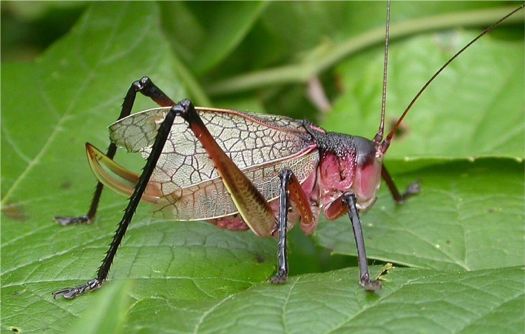
(Red-form; female - note the ovipositor)
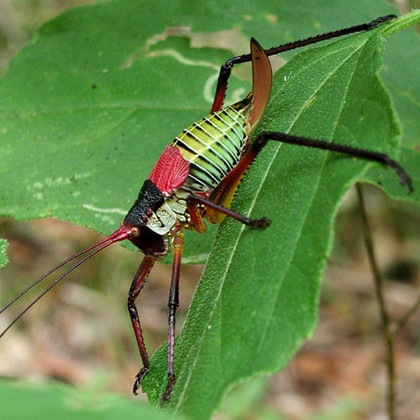 |
(Nymph, red-form, female)
More Photos: Red form, Red form, Green Form, Green Form, Outbreak
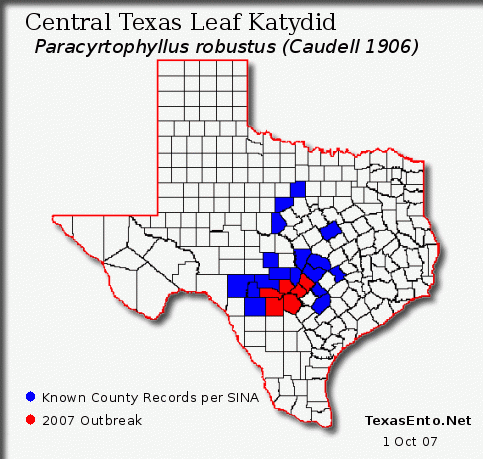 |
Note, this species actually ranges north to central Oklahoma
Primary Map Source: Singing
Insects of
North America
--> Send reports of new county outbreaks here <--
Range: Basically San Antonio up to Oklahoma City, but most common across Central Texas.
Sound file of one individual singing - A quick raspy z-z-z-z-z-z song lasting about a third of a second, repeated at two to six second intervals.
This is dominant insect sound heard nightly across Central Texas each summer.
During population outbreaks, the songs of hundreds if not thousands of katydids overlap to produce a constant pulsating whine that goes on day and night!
(Sound file recorded by Lee Elliot at Government Canyon SNA, San Antonio, TX around noon (!) on June 3, 2007.)
Identification:
Length 1.3 - 1.7 inches.
Forewings are broad near the tips, leaf-like and are slightly convex thus forming a cup around the abdomen.
Photos: Red form, Red form, Green Form, Green Form
Red forms predominate during outbreaks, hence the common name "red katydid"
Interesting discussion of different katydid with brown/green dimorphism
The Common True Katydid (Pterophylla camellifolia) of east Texas has more elongate wings
Habitat: Oak woodlands.
Season: Adults sing primarily late May to mid-July, but can be heard until September.
Life cycle:
BugGuide:The Red Katydid is an arboreal (tree-dwelling) species found mostly in oaks.
They feed primarily on oaks (Quercus spp.) to the exclusion of other nearby woody plants.
Like most Orthoptera, they have one generation per year and the egg is the overwintering stage.
The green form generally sings nightly from the tree tops and is more often heard than seen.
The red (outbreak) form can be found anywhere and may sing day and night!
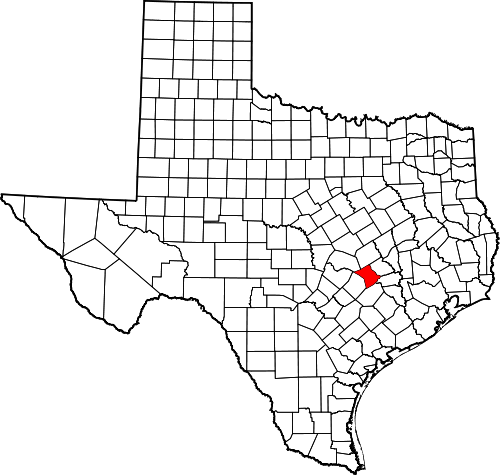
Lee County, Texas (map) - 2001
Portion of 1000-2000 acres of post oak trees impacted in 2001
Large number of adult katydids on post oaks in Lee County
Post oaks defoliated Lee County
Remarks of Dr. John Oswald, Texas A&M University on the 2001 outbreak in Lee County:
"We observed several areas of almost totally defoliated post oak trees (Quercus stellata) in localized patches of up to tens of acres. Many of the trees were stripped entirely bare of leaves. [...] When we visited the site on 14 July 2001 the population was in decline and the ground under areas of defoliated canopy was littered with the dead bodies of thousands of individuals. [...] The rancher, who had been living in the same house for 30 years, said that he had never noticed the species before, and had certainly never had such an outbreak before on his property. Interestingly, the species appeared to be feeding almost exclusively on the post oaks. There were also many elms (Ulmus alata and/or U. crassifolia) mixed in the forest, but they were still green with leaves." [link to full quote]
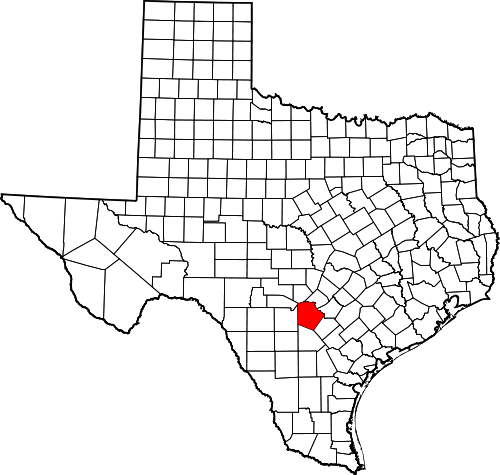
Bexar County, Texas (map) - 2007
On May 31, 2007 Bill Carr of the Texas Nature Conservancy reported from Government Canyon State Natural Area:
"We saw literally hundreds of the beasts, most or maybe all of them feeding on the foliage of plateau live oak (Quercus fusiformis). And we could see only the lower branches of most of those trees."
Medina County, Texas (map) - 2010
The following report was made on June 21, 2010:
The area 7 miles north of Quihi, TX [...] (in northern Medina Co.) is swarmed with these Katydids for the past month that seems to be having a devastating effect on the oak population. The katydids moved in about a month ago after a large flash flood (12+ inches of ranch) ripped through the area. Shortly after the flood, thousands of katydids moved in and began feeding. They are everywhere…the ground “crunches” as you walk through the yard! Entire oak trees appear to be stripped of all their vegetation. In past two weeks, most of the oaks have either lost all their vegetation, or have essentially turned brown. [...] We have 75 acres, and it would seem that nearly all of our oak trees have been dramatically impacted. And looking over the valley, it would seem everything in sight on neighboring properties has suffered the same fate.
Causal agents of the 2012 Outbreak:
The 2012 outbreak may have been induced by the following weather conditions:
Control:
Unless you have a few small to medium-sized high value oaks, chemical control is generally not advised during outbreaks due to the very large numbers of individuals present.
Here's what Texas Ag extesion says about control: Central Texas faces new red katydid invasion - AgriLife, May 23, 2012
Most Orthopteran control methods are written for Grasshoppers, e.g.: Problem Invertebrates: Grasshoppers
Etymology:
"Central Texas Leaf-Katydid"
First used by Taber & Fleenor (2003), this name is more descriptive than "Truncated True Katydid," proposed on the Singing Insects of North America website and used by Capinera et al, 2005.
"Red Kaytidid"
Red Katydid is a common name for this species as during outbreaks the red forms predominate.
Taxonomy:Paracyrtophyllus robustus Caudell 1906
para (G). Beside, beyond, near
cyrto (G). Curved, convex
phyllus (G). A leaf
robust (L). Strong; an oak
Family Tettigoniidae - Katydids - Long-horned Grasshoppers:
Katydids are sometimes called "longhorn grasshoppers" due to their long antennae.
Wings are almost always present. Species that produce songs do so by rubbing the forewings together.
Ovipositors are usually long and blade-like.
Katydids songs sound buzzy, raspy, or whiney and call mostly at night (however, this species can sing day and night during population outbreaks.)Subfamily Pseudophyllinae - True Katydids - Leaf-Katydids:
Leaf-like wings form cups enclosing the abdomen. The cupped wings may serve to amplify their sounds. Antennae longer and stiffer than in other katydids.
Most true katydids occur mainly in mature trees on which they feed. Their songs, made mostly at night, are loud and raucous, and their numbers are often great. In many areas they are the katydids most frequently heard.
True katydids are not adapted to long range dispersal. Their only "flight" is a downward fluttering when disturbed from their perch.
Similar Species: Subfamily Pseudophyllinae - True katydids (Leaf katydids)
About 1000 species worldwide in this subfamily which is especially well represented in the New World tropics.
However, only four species occur in the United States. Although similar, they are placed in three genera.Texas Taxa: Three species (in two genera) occur in Texas
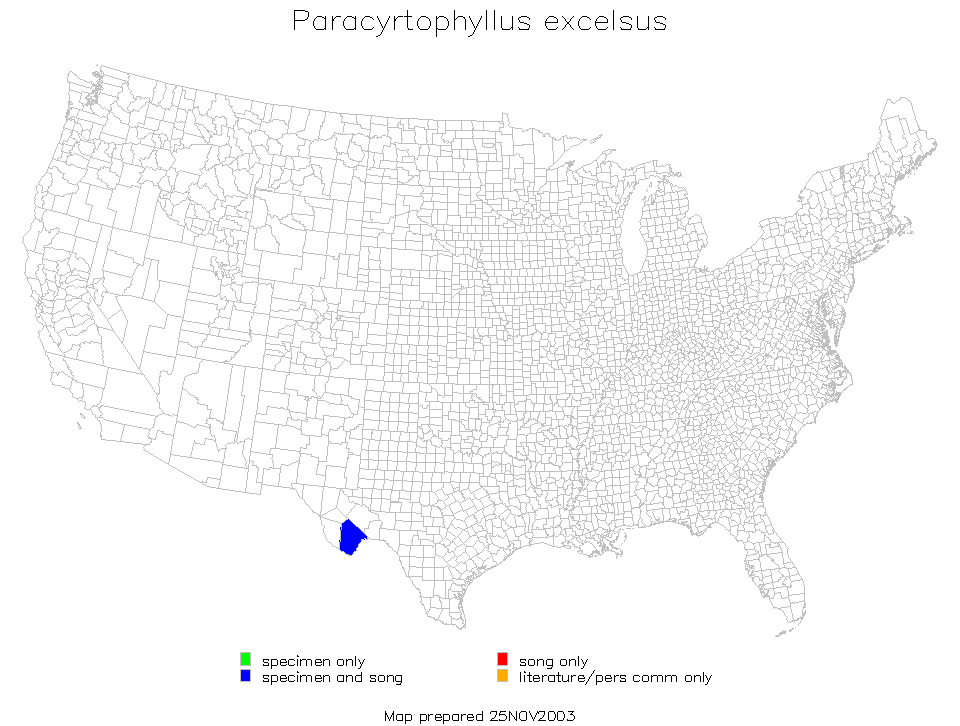
Chisos katydid - Paracyrtophyllus excelsus (Rehn and Hebard 1914) - Chisos Mountains, Big Bend NP, Texas - Map
Truncated true katydid - Paracyrtophyllus robustus (Caudell 1906) - Central Texas (aka the Red or Central Texas Leaf-Katydid)
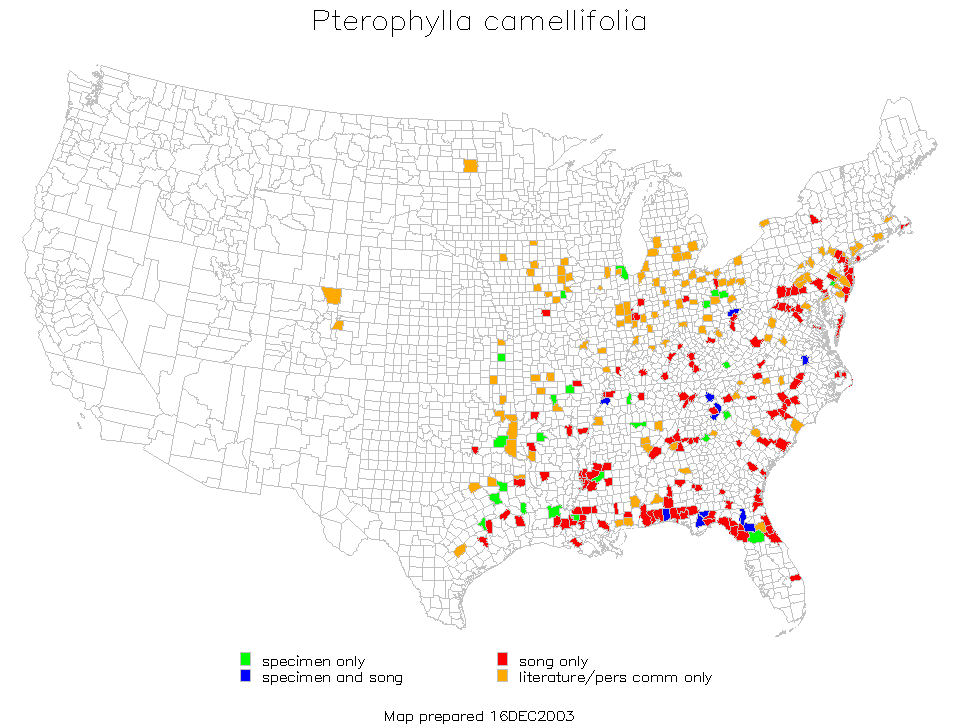
Common true katydid - Pterophylla camellifolia (Fabricius 1775) - Eastern U.S. to east Texas, has more elongate wings than the Red Katydid - Map
- Songs of this eastern species sound like "ka-ty-did" which is the origin of the name "Katydid".
Capinera, J.L., R.D. Scott, & T.J. Walker. 2005. Field Guide to Grasshoppers, Katydids, and Crickets of the United States. Cornell University Press, Ithaca, New York. 280 pp.
Caudell, A.N. 1906. Class I, Hexapoda. Order XI, Orthoptera. The Cyrtophylli of the United States. Journal of the New York Entomological Society 14: 32-45.
Hebard, M. 1941. The group Pterophyllae as found in the United States (Tettigoniidae: Pseudophyllinae). Transactions of the American Entomological Society 67: 197-219, 2 pl.
Taber, S.W. & S.B. Fleenor. 2003. Insects of the Texas Lost Pines. Texas A&M University, College Station. 283 pp.
Whitesell, J.J. 1974. Geographic variation and dimorphisms in song, development, and color in a katydid: field and laboratory studies (Tettigoniidae, Orthoptera). PhD dissertation. University of Florida, Gainesville. 75 pp.
31 May 2018 © Mike Quinn / entomike@gmail.com / Texas Entomology / Katydids of Texas