|
|
Return to Texas Entomology - Compiled by Mike Quinn
|
|
Photos - TX Records - 1939 Migration - Host Maps - U.S. Data - Similar spp. - Bibliography
Per Smith (1983b), Urania
fulgens, like all uraniids, undergoes population explosions
and
massive migrations that may be unsurpassed by any other insect in the
Neotropics.
In Costa Rica and Panama, the first population movements may begin in
July and early August and,
depending on the year, may be very massive indeed, continuing unabated for as long as five months.
| Florida County Records: Levy, Okaloosa, and Pinellas 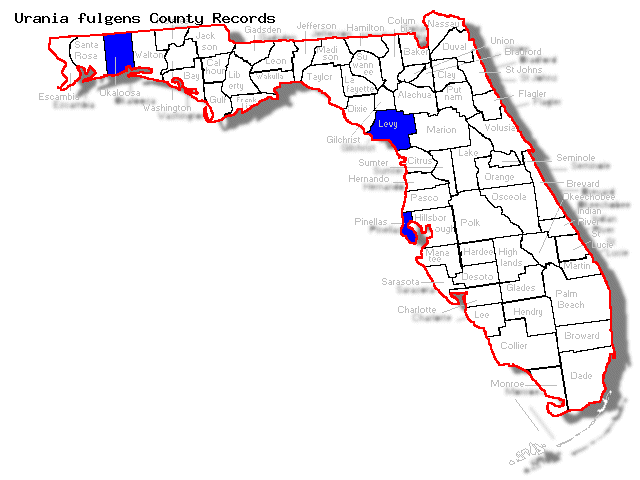 compiled 26 Oct 2011 |
Plus Bastrop Co. TX, per B. Freeman, 2011
Plus Balmorhea State Park, Reeves Co., 2017
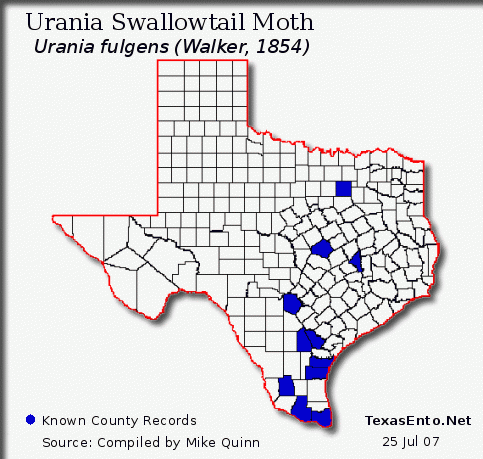
In July 1939 at San Benito, Cameron Co., Texas, Jack B. Prentiss observed a migration of U. fulgens during the morning hours, in a pasture behind his home. In a personal communication he stated, "The flight was rather extensive; there were always a few in sight for the better part of 4 hours. They were all flying in a due north direction. During the height of the flight they were rather numerous; 20 to 30 could be seen at one time. Most were flying too high to be netted and all were flying fast. Those flying low were most elusive and one had but a single chance to net them. During the course of the flight I did manage to take 2 specimens; one was in extremely good condition, the other only fair. (Kendall, 1978)
|
|
|||||
| TX | Bee Co. | Beeville | June 17, 1916 | 1 worn female | 1st U.S. Record (Leussler 1918) |
|
|
|||||
| TX | Cameron Co. | San Benito | July 1939 | A migration, 2 specimens, 1 extremely fresh, 1 fair | |
|
|
|||||
| TX TX TX |
Dallas Co. Dallas Co. Bexar Co. |
Lancaster Lancaster nr. San Antonio |
April 08, 1941 April 11, 1941 April 06, 1941 |
1 worn female 1 worn female 1 worn male |
(Kendall, 1978) (Kendall, 1978) (Kendall, 1978) |
|
|
|||||
| TX | Brazos Co. | College Station | Dec. 27, 1955 | 1 worn female | (Kendall, 1978) |
|
|
|||||
| TX | Live Oak Co. | George West | Sept. 05, 1971 | 1 worn female | (Kendall, 1978) |
|
|
|||||
| FL | Okaloosa Co. | Fort Walton Beach | Sept. 09, 1973 | 1 worn male | FL panhandle (Emmel & Farkas, 1974) |
|
|
|||||
| TX | Bexar Co. | San Antonio | Date Unk. | 1 male | (pre-1978) |
|
|
|||||
| LA | Offshore Oil Platform | Sept. 11, 1998 | Unpublished, but reportedly was actually U. leilus | ||
| TX TX TX |
Cameron Co. Jim Hogg Co Kleberg Co. |
San Benito Riviera |
Nov. 01, 1998 Dec. 17, 1998 Dec. 20, 1998 |
||
|
|
|||||
| TX | Hidalgo Co. | Mission | Nov. 07, 2003 | 1 photographed | missing one tail |
|
|
|||||
| TX | Cameron Co. | Brownsville | ca. Aug. 07, 2005 | ||
| TX | Cameron Co. | Brownsville | Aug. 15, 2005 ** | ||
| TX | Cameron Co. | Harlingen | Aug. 15, 2005 | 2, 1 photographed | slightly worn |
| TX | Cameron Co. | Laguna Atascosa NWR | Aug. 15, 2005 | 1-2 seen | |
| TX | Hidalgo Co. | Weslaco | Aug. 15, 2005 | 2, 1 collected | |
| TX | Kleberg Co. | Kingsville | Aug. 15, 2005 | 1 photographed | Nectaring on a hummingbird feeder!!! |
| TX | Hidalgo Co. | Donna | Aug. 16, 2005 | ||
| TX | Nueces Co. | Robstown | Sept. 26, 2005 | ||
| TX | Cameron Co. | Laguna Atascosa NWR | Oct. 12, 2005 | 1 photographed | missing tails |
| TX | Bell Co. | Killeen | Nov. 09, 2005 | 1 photographed | quite fresh! |
|
|
|||||
| TX | Hidalgo Co. | nr. La Lomita, Mission | Oct. 21, 2007 | 1 collected | quite worn male |
| TX | Hidalgo Co. | Bentsen St Pk, Mission | Nov. 14, 2010 | 1 photographed | Somewhat worn |
| TX | Bastrop Co. | nr. Utley | May 8, 2011 | 1 seen two times | FIDE Brush Freeman |
| FL | Levy Co. | Cedar Key | Oct 19, 2011 | 1 photographed | In good condition, (seen by MAQ) |
| FL | Pinellas Co. | South Pasadena | Oct 19, 2011 | 1 coll. & photo | In good condition |
| TX |
Hidalgo Co. |
Dec. 23, 2011 |
1 photographed |
In very good condition (seen by MAQ) |
|
|
|
|||||
| TX |
Cameron Co. |
South Padre Is. Con. Ctr |
Feb. 2, 2017 |
1 photographed |
missing tails, (pix seen by MAQ) |
| TX |
Reeves Co. |
Balmorhea State Park |
Mar. 12, 2017 |
1 photographed |
Somewhat worn. (Pic seen by MAQ) |
| TX | Nueces Co. | Flour Bluff, Corpus Ch. |
Oct. 10, 2017 |
1 photographed |
|
|
|
|
There are approximately 50 described species within Uraniidae in seven genera. (Lees & Smith, 1991).
Urania genus is restricted to the Neotropics:
Urania boisduvalii - Cuba; Hosts: Omphalea hypoleuca, O. trichotoma, and possibly a third species.
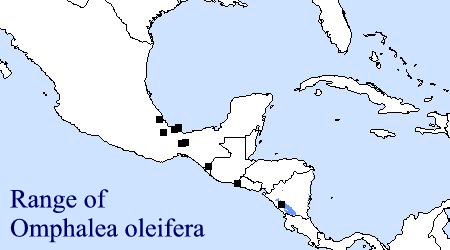
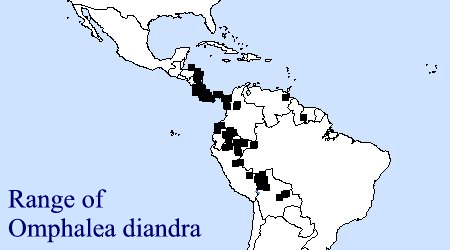
Urania fulgens - Veracruz, Mexico, throughout Central America to northern Ecuador west of the Andes; Hosts: Omphalea diandra, O. oleifera
Urania leilus - South America east of the Andes, Trinidad. Occasionally strays to other Caribbean Islands. Host Omphalea diandra.
Urania poeyi - Cuba; Host: Omphalea triandra
Urania sloanus - Jamaica, went extinct in the late 1800's. Host: Omphalea triandra
Haiti and the Dominican Republic each have a species of Omphalea and are the only place in the world where Omphalea occurs without a Uraniid.
Photo of rare mass laying of eggs on Omphalea diandra, (Euphorbiaceae)
urani, -o (G). The heavens
fulgen (L). Flash, gleam
Urania papers:
Belt, T. 1874. The naturalist in Nicaragua. John Murray, London. 403 pp.
DeVries, P.J. & T.R. Dudley. 1990. Flight physiology of migrating Urania fulgens (Uraniidae): flight speeds, body-size, thermoregulation, and lipid reserves in natural free flight. Physiological Zoology 63: 235-251.
DeVries, P.J., & Dudley, R., 1990, Morphometrics, airspeed, thermoregulation, and lipid reserves of migrating Urania fulgens (Uraniidae) moths in natural free flight: Physiological Zoology, 63: 235-251.
Dudley, R. & P.J. DeVries. 1988. Flight physiology of migrating Urania fulgens (Uraniidae) moths. American Zoologist 28: 102.
Dudley, R. & P.J. DeVries. 1990. Flight physiology of migrating Urania fulgens (Uraniidae) moths: kinematics and aerodynamics of natural free flight. Journal of Comparative Physiology A 167: 145-154.
Dudley, R., R. B. Srygley, E. G. Oliveira, and P. J. DeVries. 2002. Flight speeds, lipid reserves, and predation of the migratory Neotropical moth Urania fulgens (Uraniidae). Biotropica 34: 452-458.
Emmel, T.C. & V.J. Farkas. 1974. Urania fulgens (Uranidae) captured in Florida. Journal of the Lepidopterists' Society, 28: 292. (Full PDF)
Kendall, R.O. 1978. Periodic occurrence of Urania fulgens (Uraniidae) in the United States. Journal of the Lepidopterists' Society 32(4): 307-309. (Full PDF)
Kite, G.C, Horn, J.M, Romeo, J.T, Fellows, L.E, Lees, D.C, Scotfield, A.M and Smith, Neal G. 1990. a-Homonokirimycin and 2,5-Dihydroxymethyl1-3,4-Dihydroxy-Pyrrolidine: Alkaloidal Glycosidase Inhibitors in the Moth Urania fulgens. Phytochemistry 29(1): 103-105.
Lees, D.C. 1992. Foreleg stridulation in male Urania moths (Lepidoptera: Uraniidae). Zool. J. Linn. Soc. 106(2): 163-170.
Leussler, R.A. 1918. Interesting butterfly occurrences at Beeville, Texas (Lep.). Entomological News 29(4): 149. (Full Text)
Meerman, J.C. & T. Boomsma. 1997. Urania fulgens and other Lepidoptera migrations in Belize, Central America. News of the Lepidopterists' Society 39(1): 8-9.
Mota, L.M. y R. Dirzo. 1996. Urania fulgens. Pp: 334-337 en: Enrique González Soriano, Rodolfo Dirzo y Richard C. Vogt (editors). Historia Natural de los Tuxtlas. Universidad Nacional Autonoma de México, México City. 647 pp.
Odendaal, F.J., and P.R. Ehrlich. 1985. A migration of Urania fulgens (Uraniidae) in Costa Rica. Biotropica 17(1): 46-49.
Skutch, A.F. 1970. Migrations of the American moth, Urania fulgens. Entomologist 103: 192-197.
Smith, N.G. 1972. Migrations of the day-flying moth Urania in Central and South America. Caribbean Journal of Science 12(2-Jan): 45-58.
Smith, N.G. 1982. Population irruptions and periodic migrations in the day-flying moth, Urania fulgens. Pp: 331-344. in: A.S. Rand, D.M. Windsor, and E.G. Leigh, Jr. (editors). The Ecology of a Tropical Forest Seasonal Rhythms and Long-term Changes. Smithsonian Institution Press, Washington D.C.
Smith, N.G. 1983a. Host plant toxicity and migration in the dayflying moth Urania. Florida Entomologist 66(1): 76-85.
Smith, N.G. 1983b. Urania fulgens (Calipato Verde, Green Urania). in: Janzen, D.H. (editor) Costa Rican Natural History, University of Chicago Press, Chicago. 816 pp.
Smith, N.G.. 1990. El Por Qué de la Migración del Lepidoptero Diurno Urania fulgens (Uraniidae: Geometroidea). Pp: 415-432. in: A.S. Rand, D.M. Windsor, and E.G. Leigh, Jr. (editors). Ecología de un bosque tropical: ciclos estacionales y cambios a largo plazo. Smithsonian Tropical Research Institute, Republic of Panama, Balboa.
Smith, N. G. 1992. Reproductive Behaviour and Ecology of Urania (Lepidoptera:Uraniidae) Moths and of their Larval Food Plants, Omphalea spp. (Euphorbiaceae). Pp: 576-593 in: Quintero A., Diomedes and Aiello, Annette (editors), Insects of Panama and Mesoamerica - Selected Studies. Oxford University Press, Oxford.
van der Heyden, T. 2006. Eine Massenwanderung von Urania fulgens WALKER, 1854 in Costa Rica, Zentralamerika (Lepidoptera: Uraniidae). - Nachrichten entomologischer Verein Apollo, N. F. 27(1/2): 55-57. (Notes on a mass migration of Urania fulgens Walker, 1854 in Costa Rica, Central America (Lepidoptera: Uraniidae).)
Walker, F. 1854. Catalogue of Lepidoptera Heterocera. List of the Specimens of Lepidopterous Insects in the Collection of the British Museum. 1: 1-278. (Full PDF)
Westwood, J.O. 1879. Observations on the Uraniidae, a family of Lepidopterous Insects, with a Synopsis of the Family and a Monograph of Coronidia, one of the genera of which it is composed. Transactions of the Zoological Society, 10(12): 1–35, 3 plates.
Young, A.M. 1970. Notes on a migration of Urania fulgens (Lepidoptera: Uraniidae) in Costa Rica. Journal of the New York Entomological Society 78: 60-70.
Urania Host Plant Papers:
Horn, J.M., D.C. Lees, N.G. Smith, R.J. Nash, L. E. Fellows & E. A. Bell. 1986. The Urania-Omphalea Interaction: Hostplant Secondary Chemistry. in: 6th International Symposium on Insect-Plant Relationships, Pau, France, June 30, 1986.
Kite, G.C., L.E. Fellows, G.W.J. Fleet, P.S. Liu, A.M. Scofield & N.G. Smith. 1988. a-Homonojirimycin [2,6-Dodepxy-2,6-Imono-D-Glycero-L-Gulo-Heptitol] from Omphalea diandra L.: Isolation and Glucosidase Inhibition. Tetrahedron Letters 29(49): 6483-6486.
Kite, G.C., Scofield, A.M., Lees, D.C., Hughes, M. & Smith, N. G. 1997. Alkaloidal glycosidase inhibitors and digestive glycosidase inhibition in specialist and generalist herbivores of Omphalea diandra. Journal of Chemical Ecology 23(1): 119-135.
Lees, D.C. & N.G. Smith. 1991. Foodplant Associations of the Uraniinae (Uraniidae) and their Systematic, Evolutionary, and Ecological Significance. Journal of the Lepidopterists' Society 45(4): 296-347. (Full PDF)
Smith, N.G. 1983a. Host plant toxicity and migration in the dayflying moth Urania. Florida Entomologist 66(1): 76-85.
Smith, N.G. 1992. Reproductive Behaviour and Ecology of Urania (Lepidoptera:Uraniidae) Moths and of their Larval Food Plants, Omphalea spp. (Euphorbiaceae). Pp: 576-593 in: Quintero A., Diomedes and Aiello, Annette (editors), Insects of Panama and Mesoamerica - Selected Studies. Oxford University Press, Oxford.
13 March 2017 © Mike Quinn / entomike@gmail.com / Texas Entomology