|
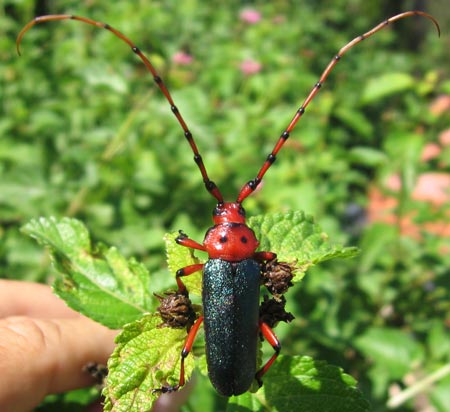
Natural Gardner, Austin, Travis Co., TX
early September 2005 (S Young & S Ashbaugh)
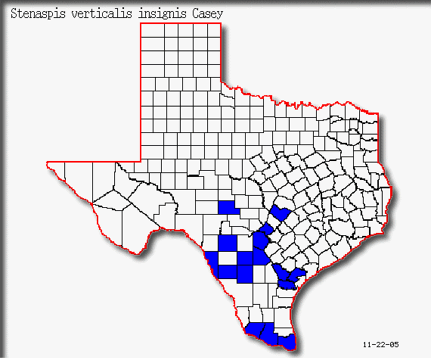
Texas County Records for Stenaspis verticalis insignis
|
Return to Texas Entomology - Compiled by Mike Quinn
|
|
|
|
County Record Source: E.G.
Riley, Nov. 2005
(Plus Kendall and Bandera Counties)
Range: South-central Texas to Northern Mexico
Description: The elytra are variably colored purple, turquoise, green or even brown. Prothorax have a variable amount of black.
Adult Activity: June to November, most specimens in the Texas A&M University Insect Collection from October.
Larval Host: Unknown, probably utilizes a living host, possibly mesquite or acacia (Dan Heffern, pers. comm.).
Biology: Adults strongly attracted to plant exudates.
Note:
On October 14, 2005, 2 miles west of Utopia, Uvalde Co., Mitch Heindel found 5 pairs incopula and a few unattached males on on Evergreen Sumac (Rhus virens) Anacardiaceae, and a couple of singles on another of the same shrub.
Similar Species: There are seven species of Stenaspis, two of which range north of Mexico.
Stenaspis solitaria (Say) - Southwestern U.S. to south Texas and northern Mexico.
Stenaspis verticalis arizonicus Casey - Arizona
Stenaspis verticalis insignis (Casey) - South-central Texas to Northern Mexico
Etymology: verticalis
Arnett, R.H., Jr., M.C. Thomas, P. E. Skelley & J.H. Frank. (editors). 2002. American Beetles, Volume II: Polyphaga: Scarabaeoidea through Curculionoidea. CRC Press. 861 pp.
Borror, D.J. 1960. Dictionary of Word Roots and Combining Forms. National Press Books, Palo Alto. v + 134 pp.
Casey, T.L. 1924. Memoirs on the Coleoptera. XI. Lancaster: New Era Printing Company. 347 pp.
Goldsmith, S.K. 1989. Feeding Ecology and the Mating System of Stenaspis verticalis arizonicus Casey (Coleoptera: Cerambycidae). Journal of the Kansas Entomological Society 62:528-533.
Hovore, F.T., R.L. Penrose & R.W. Neck 1987. The Cerambycidae, or longhorned beetles, of southern Texas: a faunal survey.
Proceedings of the California Academy of Sciences, 44(13): 283-344, 20 figs.
14 Sept. 2011 © Mike Quinn / entomike@gmail.com / Texas Entomology / Texas Beetle Information